
As global supply chains become increasingly complex and customer expectations for faster delivery continue to rise, traditional warehouse operations are facing unprecedented pressure. Manual picking methods and conventional storage processes can no longer support the speed, accuracy, and flexibility required by modern logistics environments.
To remain competitive, more enterprises are accelerating the transition toward Intelligent Warehouse automation and high-efficiency pallet handling systems.
Why Warehouse Automation Has Become Essential
Today’s warehouses must manage a growing number of operational challenges, including:
- Rising labor expenses
- Increasing order volumes
- Limited warehouse space
- Higher SKU complexity
- Faster delivery expectations
- Labor shortages during peak seasons
Traditional manual operations often result in long walking distances, low picking efficiency, and increased operational errors. As order frequency rises, warehouses relying heavily on labor struggle to maintain stable throughput and service quality.
By comparison, automated warehouse systems provide scalable operational capacity while significantly reducing dependence on manual labor.
Pallet-to-Person Robotics: A More Efficient Warehouse Model
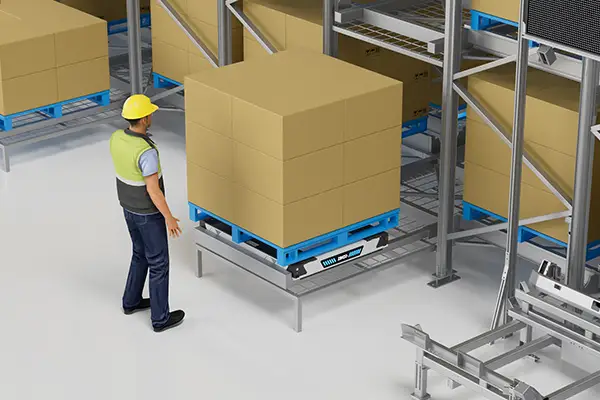
Pallet-to-person automation fundamentally changes the way warehouse picking operations are performed.
Instead of requiring operators to travel throughout the warehouse to retrieve inventory, goods are automatically transported directly to workstations. This dramatically reduces unnecessary travel time and improves picking productivity.
ZIKOO Robotics has developed a fully integrated pallet-to-person warehouse solution that combines multiple intelligent robotic systems into a unified Automatic 3D warehouse platform.
Core Robotics Systems Behind the Solution
U-Bot Omnidirectional Stacker Robot
The U-Bot operates efficiently within narrow aisles as small as 2100 mm, enabling flexible pallet handling and improving warehouse space utilization.
Its omnidirectional movement capability supports highly dynamic warehouse operations while maximizing Dense Storage performance.
R-Bot Four-Way Shuttle
The R-Bot Four-Way Shuttle enables intelligent horizontal pallet transportation within high-density racking systems.
The shuttle can move freely across multiple lanes, improving inventory accessibility and operational flexibility.
H-Bot High-Speed Lift System
The H-Bot provides rapid vertical transportation between warehouse levels, allowing efficient coordination between different storage floors.
Combined with the shuttle system, it forms a highly efficient three-dimensional warehouse transportation network.
Key Advantages of Pallet-to-Person Warehouse Automation
Significantly Improved Picking Efficiency
By eliminating long operator travel paths, pallet-to-person systems can reduce walking time by up to 70%, dramatically increasing warehouse productivity and order processing speed.
Higher Picking Accuracy
Automated workflows and intelligent system coordination help achieve picking accuracy rates exceeding 99%, reducing costly operational mistakes and inventory discrepancies.
Better Space Utilization
Through Dense Storage layouts and vertical warehouse design, businesses can maximize cubic storage capacity while reducing warehouse footprint requirements.
Improved Workplace Safety
Reducing manual traffic within warehouse aisles lowers the risk of workplace accidents and creates a safer operating environment for warehouse personnel.
Smart Warehouse Software: The Core of Intelligent Operations
Efficient warehouse automation depends not only on robotics hardware but also on intelligent software coordination.
ZIKOO’s PTP Smart Warehouse Software platform integrates:
- WMS (Warehouse Management System)
- WES (Warehouse Execution System)
- WCS (Warehouse Control System)
- RCS (Robot Control System)
This unified intelligent platform enables:
- Real-time inventory visibility
- Intelligent task scheduling
- Dynamic route optimization
- Equipment coordination
- Predictive operational analytics
The system ensures that robots, conveyors, lifts, and warehouse equipment operate collaboratively and efficiently under dynamic warehouse conditions.
Flexible Integration with Existing Enterprise Systems
Many enterprises already operate ERP or legacy WMS platforms. Replacing existing systems entirely can be both expensive and operationally risky.
To support gradual warehouse modernization, ZIKOO Robotics provides flexible API-based integration capabilities that support:
- Existing ERP system connectivity
- WMS integration
- Phased automation implementation
- Low-risk warehouse upgrades
- Continuous warehouse operation during deployment
This allows businesses to modernize warehouse operations without disrupting existing workflows.
Key Considerations for Successful Warehouse Automation
Successful Intelligent Warehouse implementation requires both advanced technology and strategic planning.
Important implementation steps include:
- Identifying operational improvement goals
- Evaluating existing warehouse bottlenecks
- Selecting experienced automation partners
- Preparing warehouse infrastructure
- Training operational staff
- Establishing long-term system optimization plans
A well-planned automation strategy helps maximize both operational performance and long-term investment value.
Long-Term ROI and Operational Value
In many warehouse applications, automation projects can achieve return on investment within approximately 2–3 years.
Key value drivers include:
- Reduced labor costs
- Increased warehouse throughput
- Improved inventory accuracy
- Lower product damage rates
- Enhanced operational safety
- Better warehouse space utilization
In high-cost industrial and urban logistics markets, maximizing existing warehouse capacity also reduces the need for costly facility expansion.
Scalable Warehouse Solutions for Future Growth
One of the greatest advantages of intelligent warehouse automation is scalability.
As operational demand increases, businesses can:
- Add additional robots
- Expand storage capacity
- Increase throughput
- Extend operational hours
- Upgrade software functionality
This flexibility allows enterprises to adapt quickly to changing market conditions while maintaining efficient warehouse performance.
The Future of Intelligent Warehouse Operations
Pallet-to-person robotics combined with intelligent warehouse software represents a major advancement in warehouse automation and supply chain efficiency.
By improving accuracy, reducing labor dependency, optimizing storage density, and increasing operational speed, modern automated warehouse systems are helping businesses build more competitive and resilient logistics operations.
As supply chains continue evolving, investing in Intelligent Warehouse technology is becoming an essential strategy for enterprises seeking long-term operational growth and sustainable logistics performance.
