
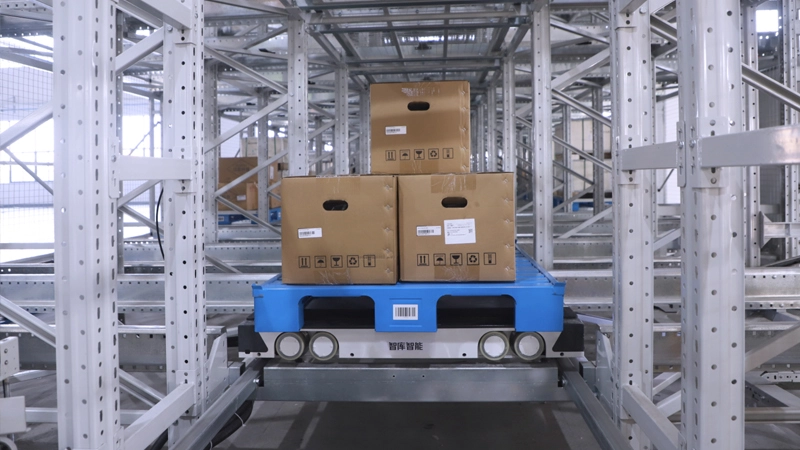
As global supply chains become more complex and warehouse efficiency requirements continue to rise, businesses are accelerating investments in intelligent logistics automation. Among the most widely discussed technologies in modern warehousing are the Four-Way Shuttle system and the AGV robot.
Although both solutions play important roles in warehouse automation, they are designed for different operational objectives and warehouse environments. Understanding their differences is essential for enterprises planning future-ready smart warehousing systems.
Understanding the Core Difference Between Four-Way Shuttles and AGVs
While both technologies automate material movement, their operational focus is fundamentally different.
Four-Way Shuttle Systems
Four-Way Shuttles are designed primarily for:
- High-density storage
- Multi-level pallet handling
- Intelligent storage optimization
- Automated storage and retrieval
Operating within racking systems, they move horizontally in four directions and coordinate with lifts for vertical transport, making them highly effective in Dense storage and Automatic 3D warehouse environments.
AGV Robots
AGV (Automated Guided Vehicle) robots are mainly used for:
- Horizontal material transportation
- Fixed-route logistics movement
- Production line delivery
- Heavy-load transport scenarios
AGVs typically operate on warehouse floors using predefined navigation routes, making them suitable for repetitive transport workflows.
Best-Fit Application Scenarios
Where Four-Way Shuttle Systems Perform Best
High-Density Storage Environments
Four-Way Shuttle systems are ideal for warehouses requiring maximum space utilization, especially where land costs are high or storage density is critical.
Typical industries include:
- Pharmaceutical logistics
- Cold chain warehousing
- E-commerce fulfillment
- Electronics manufacturing
- Retail distribution
Their flexible path planning and intelligent scheduling capabilities allow dynamic adjustment of storage layouts according to SKU demand and inventory turnover.
High-SKU and Dynamic Inventory Operations
Warehouses handling large SKU quantities and frequent inbound/outbound activity benefit greatly from shuttle-based intelligent storage systems.
The ability to optimize storage positions automatically helps improve picking efficiency and inventory accuracy.
Where AGV Robots Deliver Strong Advantages
Heavy-Duty Industrial Transportation
AGV robots are highly effective for transporting large or heavy materials between fixed production areas.
Typical use cases include:
- Automotive manufacturing
- Industrial assembly lines
- Raw material transfer
- Repetitive logistics transport tasks
Standardized Warehouse Layouts
AGVs perform efficiently in environments with predictable operational flows and stable transport routes.
Their flexibility in floor-based movement makes them suitable for connecting production lines, staging areas, and warehouse transfer zones.
Hybrid Automation: The Future of Intelligent Warehousing
Rather than competing directly, Four-Way Shuttles and AGV robots increasingly work together within integrated warehouse ecosystems.
Many modern intelligent warehouses combine:
- AGVs for horizontal transportation
- Four-Way Shuttles for dense storage and retrieval
- Conveyors for continuous flow handling
- WMS/WCS software for intelligent coordination
This hybrid automation strategy allows enterprises to optimize both storage density and transportation efficiency simultaneously.
Zikoo Robotics has developed integrated intelligent warehousing solutions that combine shuttle systems with robotic transport technologies, enabling smoother material flow and higher operational throughput.
Key Factors When Choosing Between AGV and Four-Way Shuttle Systems
1. Storage Density Requirements
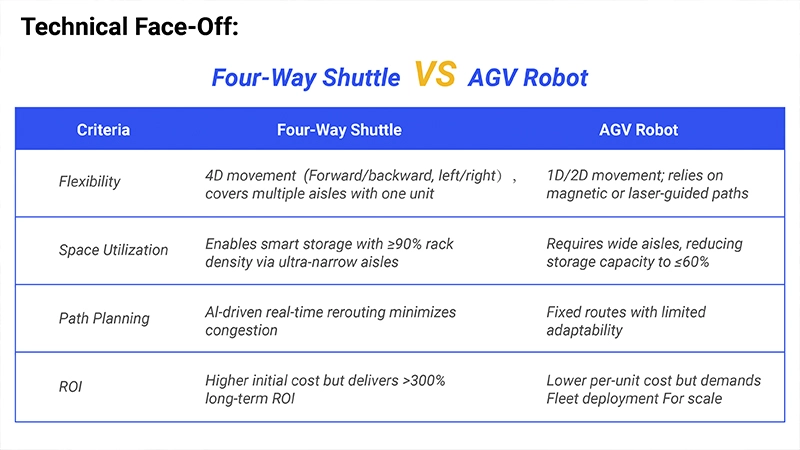
If maximizing warehouse capacity is the priority, Four-Way Shuttle systems provide significantly better vertical space utilization.
2. Operational Flexibility
Warehouses with frequent SKU changes and dynamic inventory movement benefit more from intelligent shuttle-based storage systems.
3. Transportation Complexity
Facilities requiring long-distance horizontal transport or production line integration may benefit more from AGV deployment.
4. Scalability and Future Expansion
Modular shuttle systems allow easier expansion within existing warehouse structures, while AGV fleets can scale flexibly according to transport demand.
5. Environmental Conditions
Certain applications require specialized automation solutions such as:
- Low-temperature cold storage
- Explosion-proof environments
- High-cleanliness pharmaceutical operations
Zikoo Robotics offers customized intelligent warehousing solutions tailored for these complex operational scenarios.
Intelligent Software: The Core of Modern Warehouse Automation
Efficient automation depends not only on robots but also on intelligent software coordination.
Zikoo’s integrated warehouse software platform combines:
- WMS (Warehouse Management System)
- WCS (Warehouse Control System)
- RCS (Robot Control System)
These systems enable:
- Real-time equipment scheduling
- Dynamic route optimization
- Intelligent task allocation
- Traffic conflict avoidance
- Warehouse-wide operational visibility
This integrated architecture ensures efficient collaboration between shuttle systems, AGVs, conveyors, and other automation equipment.
Why Enterprises Choose Zikoo Robotics
As a rapidly growing innovator in intelligent logistics automation, Zikoo Robotics provides advanced solutions for global warehouse transformation.
Key advantages include:
- Extensive experience in Dense storage projects
- Intelligent multi-robot coordination technology
- Strong software integration capabilities
- Proven deployments across multiple industries
- Flexible customization for complex warehouse environments
- Global project delivery and support capabilities
From pharmaceuticals and cold chain logistics to manufacturing and e-commerce, Zikoo continues to help enterprises build smarter, more scalable, and more efficient warehouse systems.
Conclusion
The future of smart warehousing is not defined by a single automation technology. Instead, success depends on selecting the right combination of intelligent systems based on operational needs, storage density requirements, and long-term scalability goals.
While AGV robots remain highly effective for material transportation, the Four-Way Shuttle continues to lead the evolution of high-density warehouse automation and Automatic 3D warehouse solutions.
By integrating intelligent robotics, advanced software systems, and flexible automation architecture, Zikoo Robotics is helping businesses worldwide build the next generation of efficient, scalable, and future-ready logistics operations.
